
Field Notes from a Disappearing World
We Built Auto Play to Help You Out. Players Use It to Draw
Auto Play was supposed to be a small helping hand for when you are stuck. Then lines started appearing across the Shared World — long, straight, one area wide — and roads reaching out from one continent toward the next.
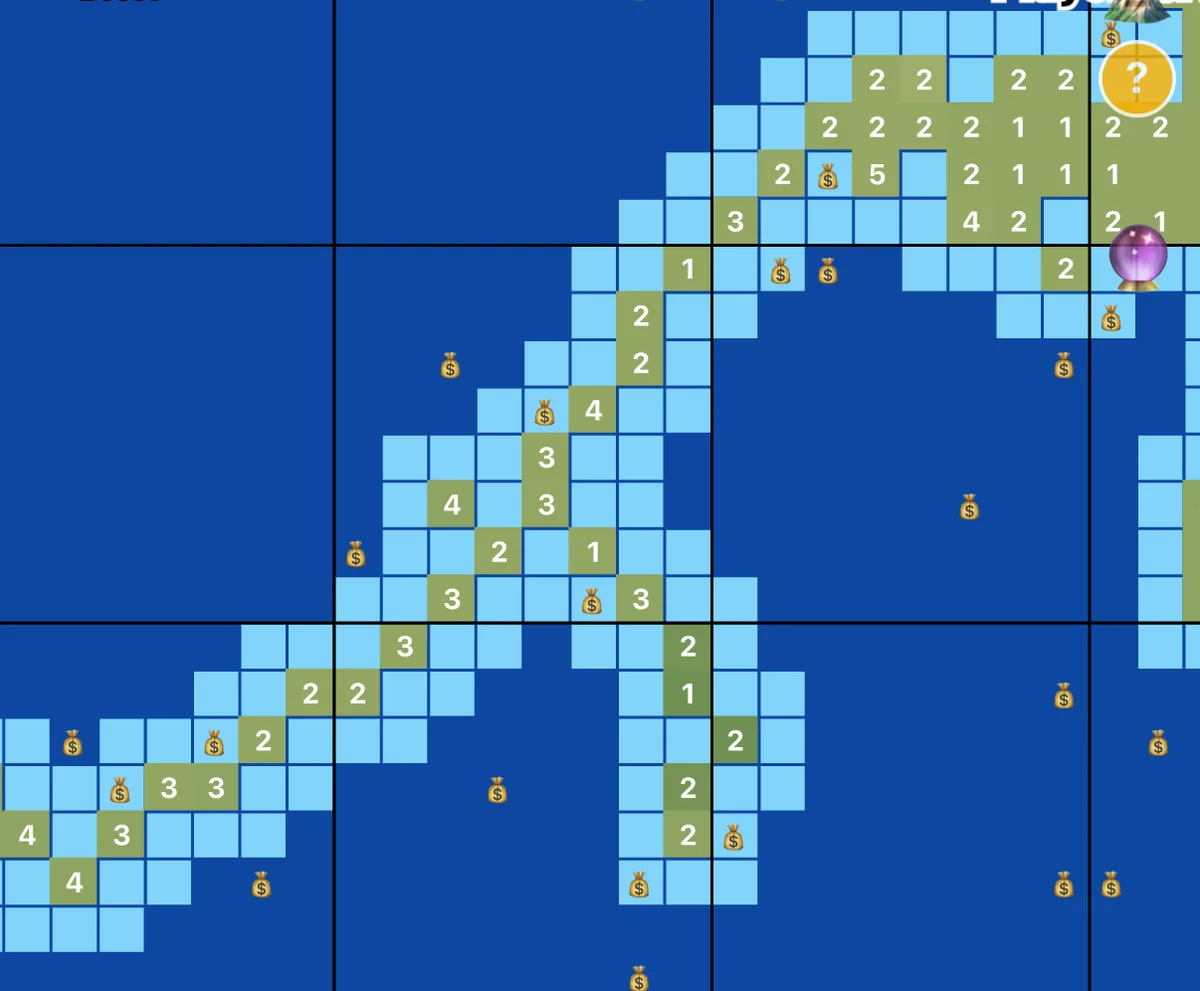
Every Minesweeper player knows the feeling of being stuck: every number around you has been read, nothing is certain, and the place you want to reach — a secret point, a gate to another world — is somewhere off past the edge of what you have opened. We added Auto Play for that moment. It is a way to spend the coins you have earned to push on when your own reading runs out.
It works very simply. You pay 10,000 coins, and at the current price of 50 coins a cell the game opens 200 cells for you, one every 25 milliseconds. (The 10,000 is fixed and the price per cell can be changed, so a lower price means more cells for the same payment.) Each time, it picks the safe cell closest to the centre of your screen that it is able to open — it never opens a mine. When the 200 are done it charges you again and carries on, until you run out of coins or you press stop; stop takes effect once the 200 you have already paid for are finished.
There is one more rule, and it matters later. If there is nothing left it can open on your screen, it does not simply stop: it picks an openable cell somewhere else in the world instead (if that cell is a mine, it plants a flag on it rather than opening it). It stops by itself only when there is nothing at all left to open.
Notice what it does not do. It does not know where you want to go. It has no target, no path and no idea about secret points or gates. Apart from that fallback, all it follows is the centre of your screen.
What we did not expect
The map stays movable while Auto Play runs. So if you slide the screen slowly in one direction, the centre moves, and Auto Play follows it, opening a trail behind. As far as we can tell, that is how a helping hand became a pen. We did not design it for this, and we did not see it coming.
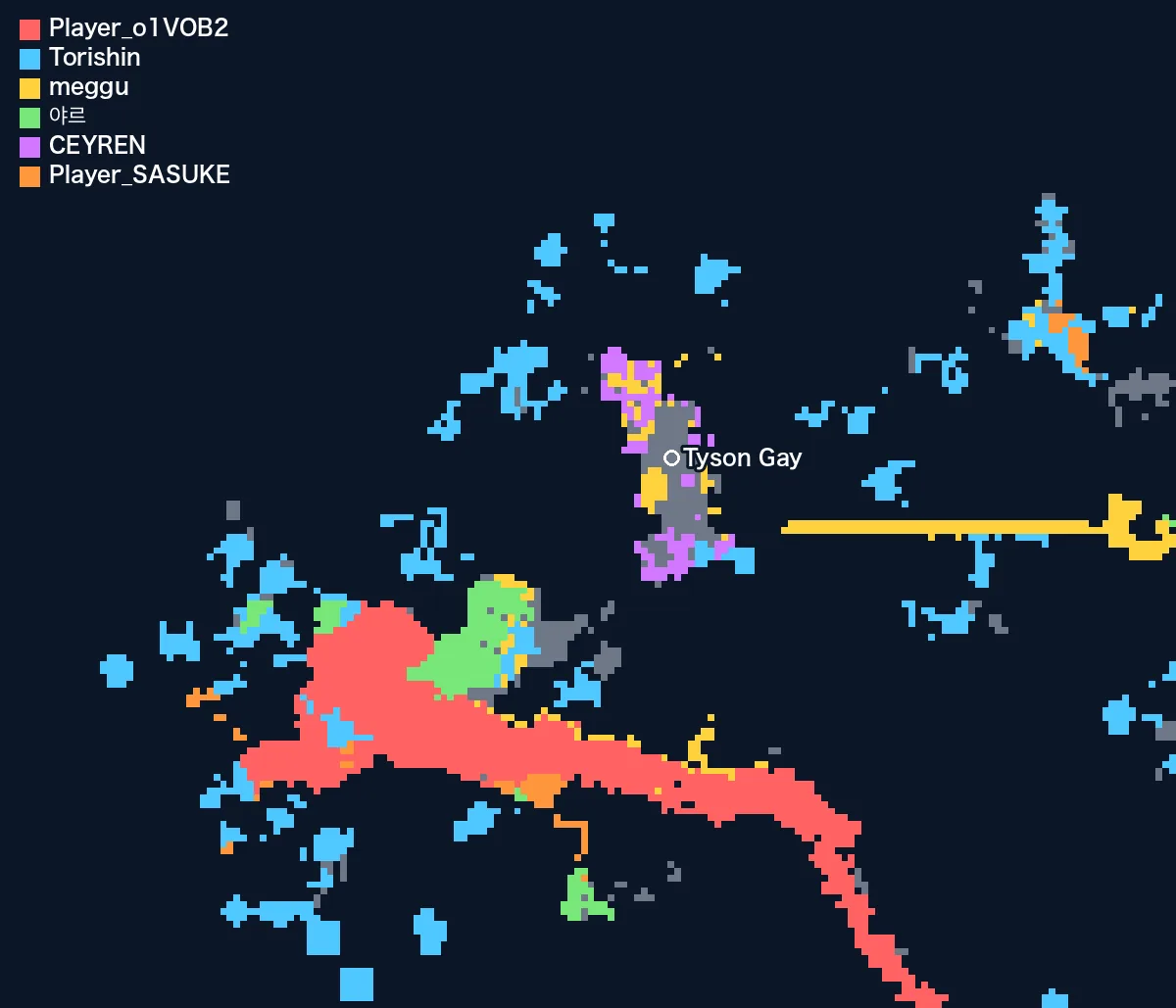
Lines began to appear on the map: long, thin and far too straight to be anyone's ordinary exploring. The picture above is from Season 6, where a single straight line runs east for dozens of areas past the continent Tyson Gay. Season 7 had more.
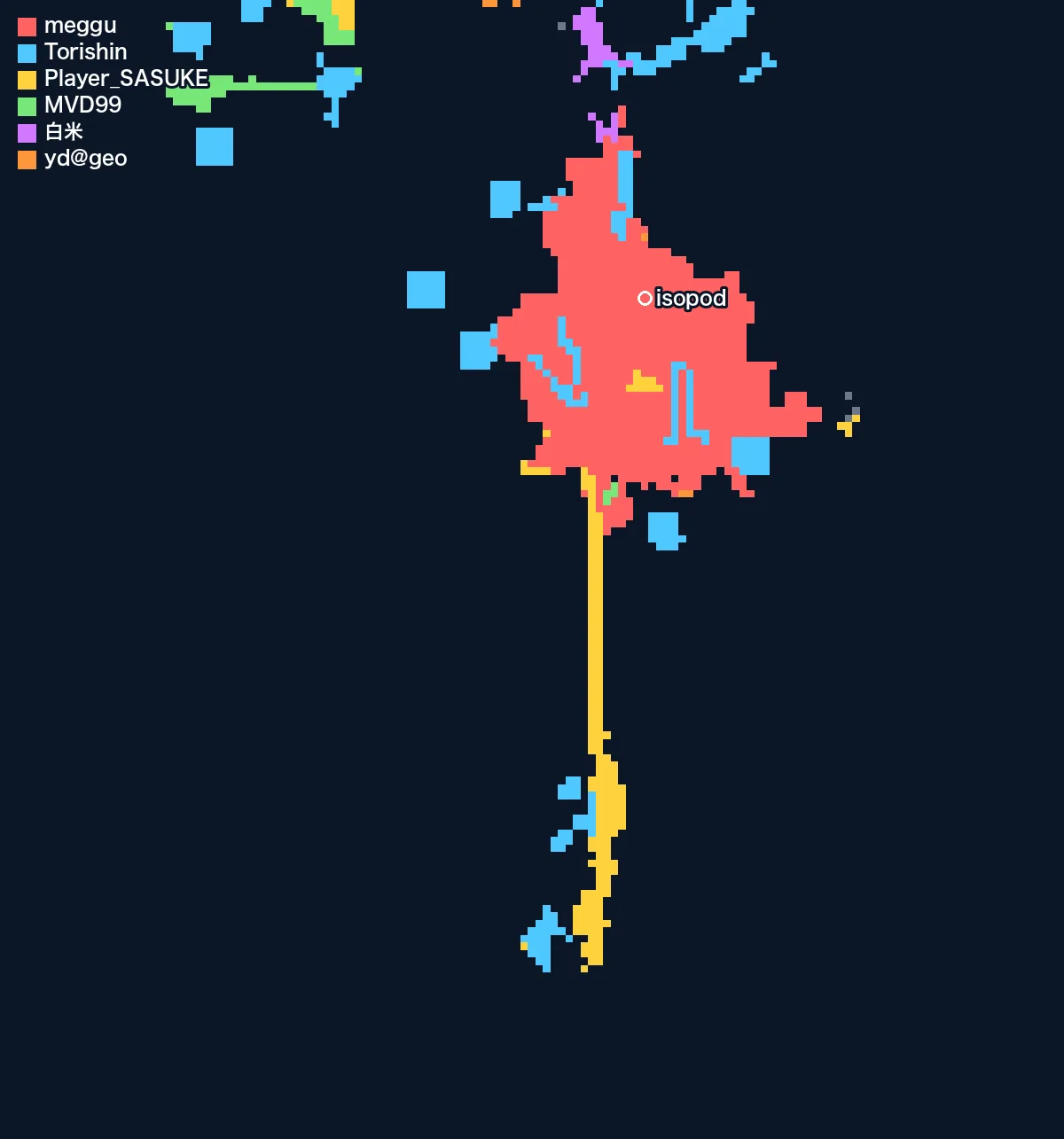
We should be honest about one thing. The game records a cleared area the same way whether you opened it by hand or with Auto Play, so we cannot point at a particular line and prove which it was. Some of these may be pure patience. What we can say is that Auto Play is not a rare trick. In Season 6, 21 players ran it 622 times and spent 6.2 million coins on it; in Season 7, 18 players ran it 627 times.
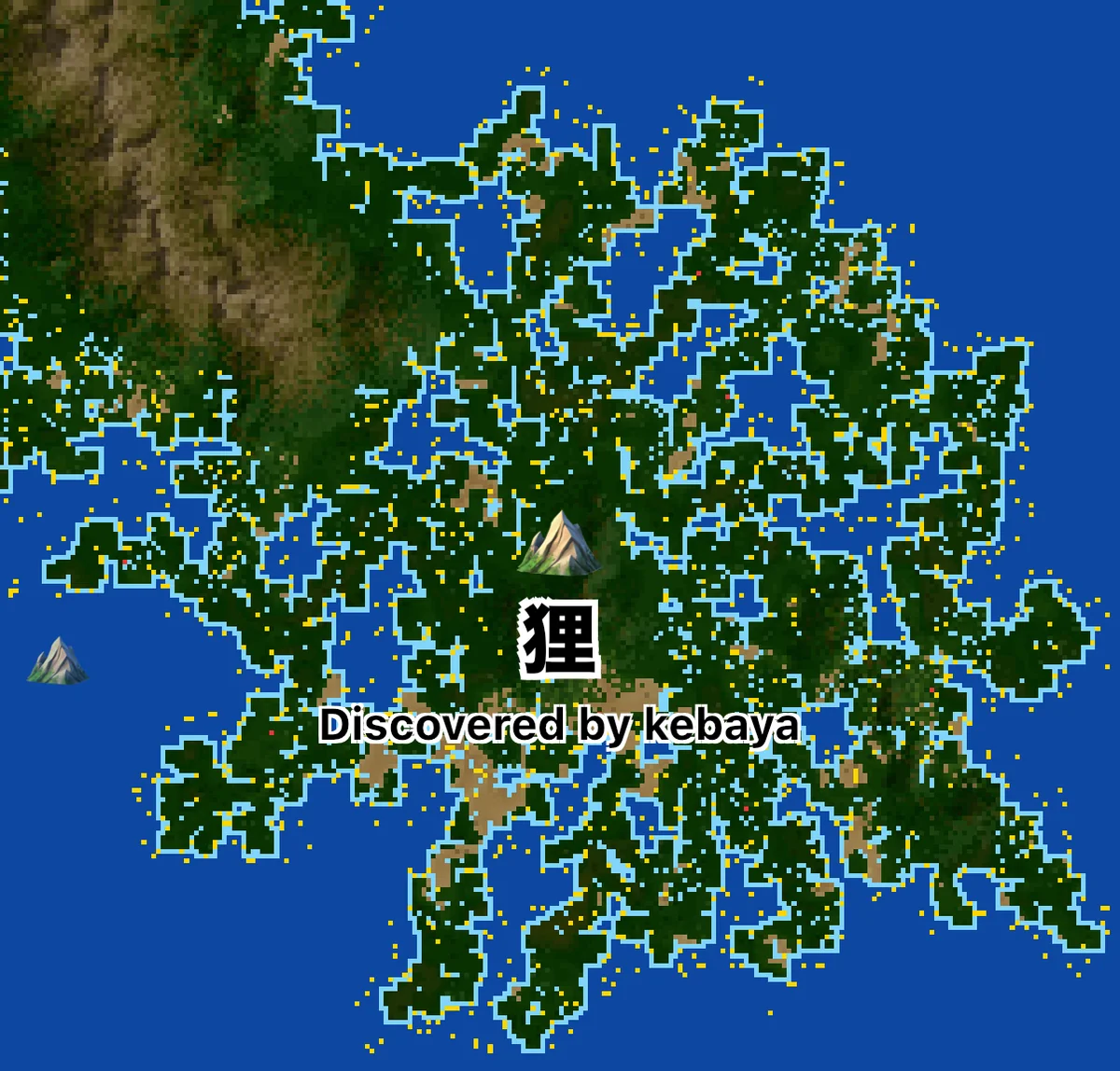
This season, around the continent 狸, the ground has been opened into something that looks like a spider's web: thin threads crossing and recrossing. The threads are made of single cells, far finer than the areas the maps on this site record, so a web like this never shows up there. You can only see it in the game itself.
Roads between continents
The other thing we did not plan is the roads. New continents are born far out in the sea, and nothing in the game rewards you for linking them to anything. Yet players keep digging toward them, and toward each other.
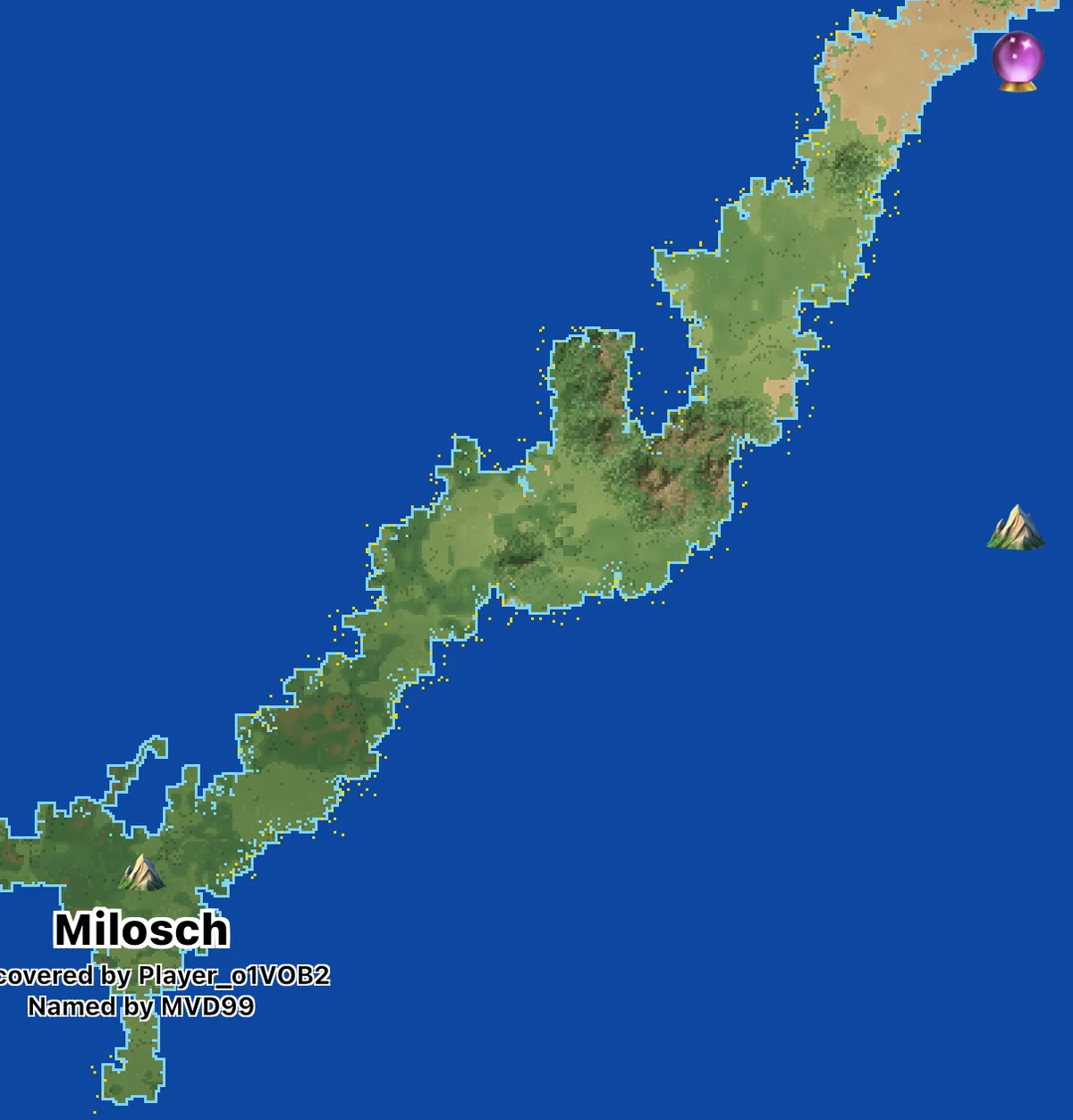
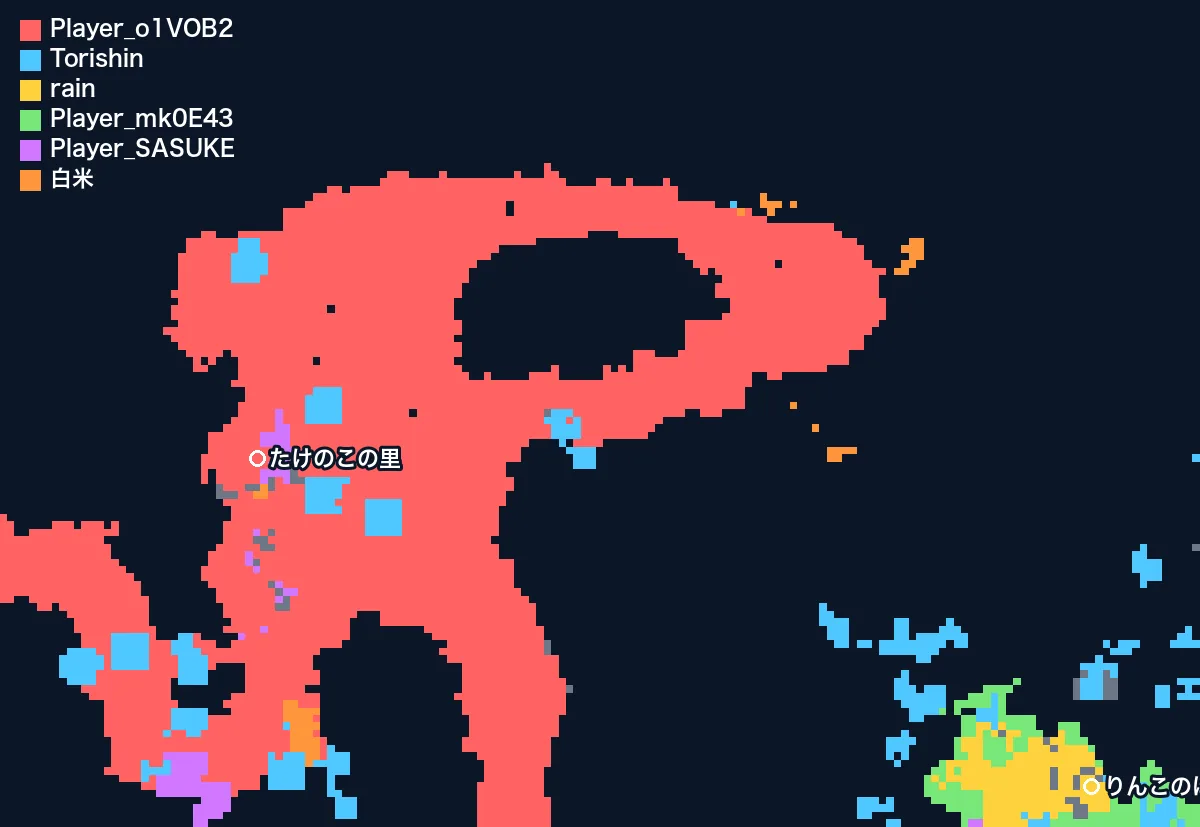
By the end of Season 7, three of its six new continents had been joined to the Origin Land by an unbroken chain of cleared areas: ガラパゴス諸島 on day 4.5, たけのこの里 on day 10.9 and りんこのほっぺ on day 13.1, on the world's last day. Others came close without making it. The settlement around 犬小屋 stopped about 21 areas short. In Season 6 only bumblebee was fully joined, while Tyson Gay's settlement ended about 10 areas from the main road.
There is no prize for connecting two continents. Nobody asked for it. We look at these maps and wonder whether people simply cannot leave two pieces of land unconnected. Maybe that is what a shared world is for.
What we learned
We built a tool to get you unstuck, and the players found a brush. The best moments in the Shared World so far are the ones nobody designed: the graves strangers dig for each other, the names people give to continents, and now the lines.
If you are stuck, try it the way we intended: point your screen at the place you want to reach and let Auto Play open the way (it can only open cells that touch ground you have already opened). And if you have coins to spare, try it the other way too. Slide the map slowly, and see what you leave behind for the next pioneer.
You can play in your browser or in the iPhone and Android app. There Is No Edge explains how continents are born and named, This World Will Be Deleted on October 26 shows the rest of Season 7's shapes, and the guide to the Shared World covers everything else.
Field Notes from a Disappearing World
What actually happens in a world that thousands of strangers dig together for fourteen days, and then lose. Written by the people who built it, with real names, coordinates and numbers.
This World Will Be Deleted on October 26
On October 26 at 15:00 UTC, the world that 60 ranked players have spent two weeks digging will close for good. It is the biggest one yet — and two players are separated by 25 points at the top.
There Is No Edge: How Players Grow the Continents
Every Minesweeper board you have ever played had an edge. This one starts as a single island in an empty sea, and the players themselves make the continents appear — then name them.
In This Minesweeper, Strangers Bury You
Hit a mine in the Shared World and you do not just lose. You lie there, on everyone's map, until a stranger comes along and buries you — and the grave keeps both your names.
Ready to try it?
Open your first cell in seconds. No sign-up, no download.
Play Minesweeper nowPlay anywhere. The mobile apps are free and include the same Shared World as the web version, so you dig alongside the same players.

